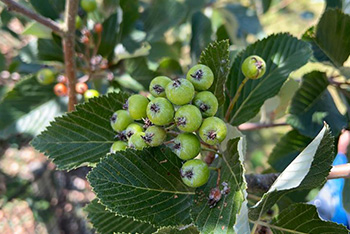
New work highlights urgent action needed to protect our rarest native trees
Conservation Gap Analysis of Whitebeams, Rowans and Service Trees Threatened in the United Kingdom and Ireland
We’re pleased to share news of the publication of the first conservation gap analysis for threatened whitebeams, rowans and service trees (Sorbus) across the UK and Ireland.
Since launching the Global Conservation Consortium for Whitebeams, Rowans and Service Trees, led by Westonbirt, The National Arboretum in collaboration with Botanic Gardens Conservation International, we’ve been building a growing network of experts and organisations committed to protecting these remarkable trees. With several conservation efforts already undertaken by organisations across the country, it was important to consider where future action should be focused to make the biggest difference. The gap analysis has helped answer this.
A global hotspot on our doorstep
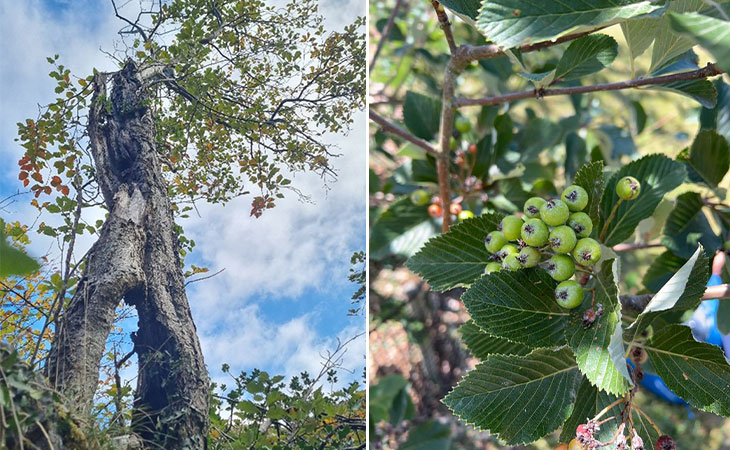
The UK and Ireland are among the most important regions in the world for Sorbus diversity. Of around 250 species globally, 45 are found here, many of them nowhere else. They are culturally and evolutionarily significant components of our ecosystems, with many species confined to single gorges, valleys or woodlands.
Despite this diversity, many are at serious risk of extinction. Twenty-one species have been assessed as Critically Endangered for the IUCN Red List of Threatened Species, 12 are Endangered and 5 are Vulnerable.
What is a conservation gap analysis?
In simplest terms, a conservation gap analysis helps us understand the threats to these species, what work is already underway and where the most urgent conservation priorities lie – both in the wild (in situ) and in botanic collections and seed banks (ex situ).
Using methodologies developed by The Morton Arboretum and Botanic Gardens Conservation International, we compiled ex situ collection data from 38 organisations across 14 countries. A Conservation Action Questionnaire also captured insights from organisations and individuals working with threatened Sorbus. Together, these enabled us to evaluate the extent of past and ongoing conservation work, identify the key threats facing these species, and determine the most urgent actions needed to protect them.
Results have been presented by regional diversity centres, with the objective of providing an evidence-based foundation for prioritising conservation actions and strengthening coordination among stakeholders in these regions.
What have we learned?
The picture is mixed. The majority of our target species are represented in at least one ex situ collection, and many organisations are already working to monitor and conserve populations.
However, significant gaps remain. Several of the most restricted and threatened species are poorly represented in collections, sometimes with only one or two individuals held. Additionally, many collections lack detailed records, constraining their long-term conservation value. Sorbus wyensis and Sorbus fayana, the two most recently described species, are absent from ex situ collections altogether.
The main threats to wild populations include pests and diseases, invasive species, grazing and changes in woodland management.
What needs to happen next?
The analysis highlights clear priorities for action:
- improving ex situ collections so they better represent wild populations
- continuing surveys and long-term monitoring
- managing habitats, including controlling invasive species and grazing
- investing in research on disease and genetics
- raising awareness of these often overlooked trees
Perhaps most importantly, Sorbus conservation cannot focus on single species in isolation. Many depend on interactions with other related trees to reproduce successfully, therefore protecting entire ecosystems and the processes that sustain them is essential.
This work provides a strong foundation for coordinated action amongst conservation organisations, botanic collections, seed banks and land managers, to ensure these unique trees remain part of our landscapes for generations to come. The full report can be found here.
We are grateful to the many institutions and individuals who contributed data through the ex situ survey and Conservation Action Questionnaire. We are also hugely grateful to Martin Wills Wildlife Maintenance Trust who generously funded this important work, and to FOWA members for their contribution.